Gaudí Walking Tour: Self-Guided in Eixample
Walk from Passeig de Gràcia to the Sagrada Família, tracing Gaudí’s architecture through Barcelona’s Eixample. Follow a practical route with suggested stops, details to spot on the façades and stories that connect the landmarks to their neighborhood.
Xploreo9 min read
Key takeaways
- A self-guided Gaudí walking tour runs from Casa Batlló through Casa Milà to the Sagrada Família without doubling back.
- Allow 100 minutes for approximately 2.5 kilometres: 40 minutes walking and 60 minutes exterior viewing, excluding interiors.
- From Casa Milà, follow Carrer de Provença to Carrer de Sardenya, then turn towards Carrer de Mallorca.
- At Casa Batlló, compare the bone-like lower columns, mask-like balconies, coloured glass and ceramic, and curved roofline.
- View Casa Milà from its corner to appreciate the flowing stone façade, then examine the irregular iron balcony railings.
- See Sagrada Família’s Passion geometry from Carrer de Mallorca and Nativity sculpture from Carrer de la Marina.
This Gaudi walking tour is self-guided and starts at Casa Batlló on Passeig de Gràcia in the Eixample. Continue to Casa Milà, then finish at the Sagrada Família. Allow approximately 2.5 kilometres and 40 minutes of walking, plus time to study the façades. The illustrative plan below allows roughly 100 minutes overall, without doubling back.
A spontaneous walk works best when the route leaves room to stop rather than packing every landmark into one outing. Barcelona’s Eixample makes that possible: its grid connects the buildings, while broad junctions offer space to study their outlines. Comfortable shoes, a charged phone and a street map cover the basics. The main choice is how much time to spend looking.
Plan a Self-Guided Tour of Gaudí’s Buildings
Illustrative planning times for an exterior walk from Passeig de Gràcia to the Sagrada Família
Stop | Street Connection from Previous Stop | Approximate Walking Time | Suggested Exterior Viewing Time | Architectural Details to Spot |
|---|---|---|---|---|
Casa Batlló | Start on Passeig de Gràcia | Start point | 15 minutes | Bone-like columns; coloured mosaic; curved roof |
Casa Milà | Passeig de Gràcia towards Avinguda Diagonal | 10 minutes | 15 minutes | Waving stone; iron balconies; corner façade |
Sagrada Família | Carrer de Provença; Carrer de Sardenya; Carrer de Mallorca | 30 minutes | 30 minutes | Nativity sculpture; Passion geometry; rising towers |
Plan for approximately 2.5 kilometres, including movement around the Sagrada Família exterior. Use the viewing allowances as a starting point, rather than a deadline at each building. Crossings, crowds and longer pauses can extend the outing, so keep your next commitment flexible.
This self-guided Gaudi walking tour starts outside Casa Batlló and finishes at the Sagrada Família, rather than returning to Passeig de Gràcia. These timings cover street-side sightseeing only. Because each building rewards a different viewing position, leave room to cross streets safely and step back. Exterior viewing does not include the courtyards, roof spaces or interiors.
Keep the distinction: Walking time measures movement between stops; sightseeing time includes standing still. A short distance can still fill a substantial part of your morning.
Follow Your Self-Guided Gaudí Walking Tour North
Begin outside Casa Batlló on Passeig de Gràcia, then walk towards Avinguda Diagonal to reach Casa Milà. From Casa Milà, take Carrer de Provença towards the Sagrada Família. Continue until Carrer de Sardenya, then turn towards Carrer de Mallorca for the Passion façade. Walk around the basilica to Carrer de la Marina for the Nativity façade.
Casa Batlló gives this self-guided Gaudi walking tour a clear starting point. Before moving on, cross Passeig de Gràcia at a marked crossing for a wider view. Return to the building side when you want to examine the lower stonework. Keep entrances clear, since other visitors and residents share the pavement.
Casa Milà stands at the junction of Passeig de Gràcia and Carrer de Provença. The corner matters because a view straight towards one wall misses how the stone continues around the building. After looking, use Carrer de Provença as your main connecting street. Street signs make the grid easier to follow than an improvised diagonal shortcut.
The Eixample’s repeated blocks can make a walk feel shorter on a map than on foot. Cross streets at the marked crossings, rather than cutting across the open corners. Those clipped corners also provide useful viewing angles. As you approach the basilica, its towers help orient you, but follow the street layout rather than aiming straight towards them.
Read the Façades on Your Self-Guided Gaudí Tour
At Casa Batlló, look at the façade in layers: the lower columns, the balconies, the coloured surface and the roofline. Gaudí gives each layer a different character. Stone appears almost skeletal below, whereas curved forms and reflective fragments animate the upper wall. Step back first, then move closer to compare the details.
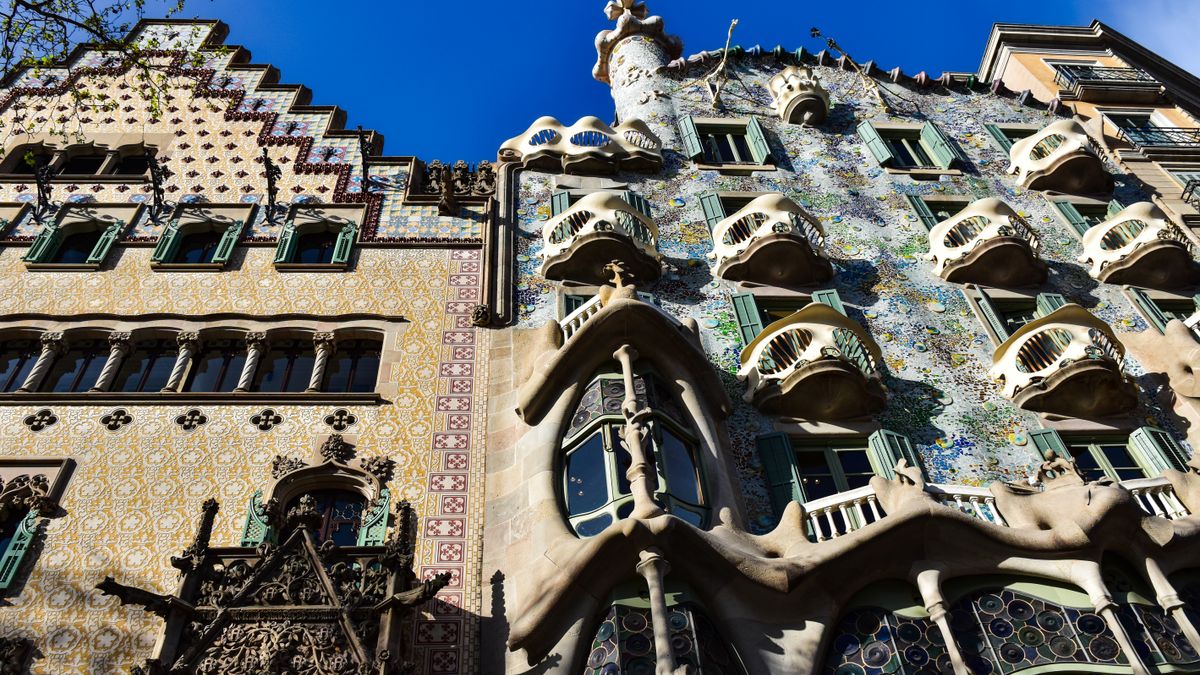
The lower columns resemble bones, and the balconies suggest masks or skulls. Above them, pieces of coloured glass and ceramic catch changing light. The roof’s scaled appearance supports a familiar reading of the building through the legend of Saint George and the dragon. Treat that reading as an interpretation, however, not a label for every shape.
Casa Batlló also rewards comparison with its neighbours. Look along the same stretch of Passeig de Gràcia before isolating Gaudí’s work in a photograph. Different rooflines, balconies and decorative choices compete for attention. The setting helps explain why an ambitious façade mattered here: the street offered a public stage for private homes.
Passeig de Gràcia connects these buildings to the Eixample’s wider story of urban expansion. The district’s regular street grid created plots where owners and architects could express status through their buildings. Gaudí worked within that framework, yet made the street-facing surface unusually fluid. The contrast between orderly blocks and restless façades runs through this self-guided Gaudi walking tour.
For a closer observation, choose one balcony and compare it with the wall around it. Notice the gaps, shadows and curved edges rather than looking only for recognisable creatures. That approach keeps the building interesting even when familiar photographs have already shown you its outline. Your eyes start finding relationships instead of collecting symbols.
Compare Casa Milà on Your Self-Guided Gaudí Walk
At Casa Milà, study the broad movement of the stone before examining individual balconies. The façade flows around its corner, unlike the straight lines of the surrounding street plan. Its rough, pale surface gives the building its familiar name, La Pedrera, meaning the stone quarry. The ironwork, in contrast, supplies a darker, tangled counterpoint.
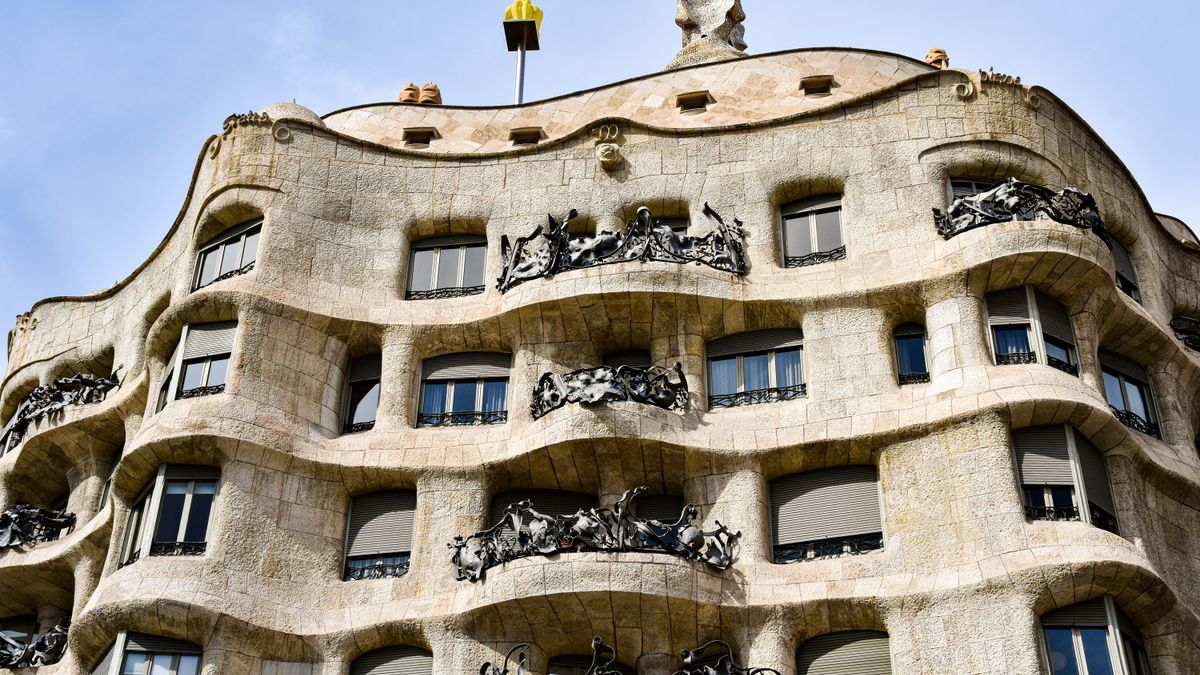
Walk far enough from the corner to see how windows sit within the rising and falling stone. Next, look at the balcony railings. Their irregular forms resist the neat repetition you might expect from a residential building. Because the façade curves, your viewing position changes the balance between solid wall, opening and shadow.
Casa Batlló and Casa Milà make a useful pair on a self-guided Gaudi walking tour. Casa Batlló draws attention through colour and concentrated detail; Casa Milà, by comparison, works through mass, texture and a continuous outline. Neither building stands apart from city life. Doors, shops, traffic and neighbouring homes keep both firmly within a working district.
The Eixample’s straight streets give Gaudí’s curves their force: the buildings become easier to read when you look at the ordinary blocks around them.
On this self-guided Gaudi walking tour, Carrer de Provença provides more than a connection between landmarks. Look at repeated balconies, internal block openings and the shape of the junctions as you go. Together, those ordinary features establish the district’s rhythm. By the time the Sagrada Família appears, you have moved from private residences towards architecture with a different public and religious purpose.
Finish Your Gaudí Tour with Self-Guided Exterior Viewing
At the Sagrada Família, compare the Passion and Nativity façades rather than treating the basilica as one front-facing view. The Passion side uses spare, angular figures and strong shadows. The Nativity side, meanwhile, gathers dense sculpture, plants and animals around scenes of birth. Their contrast makes a rewarding finish to this self-guided Gaudi walking tour.
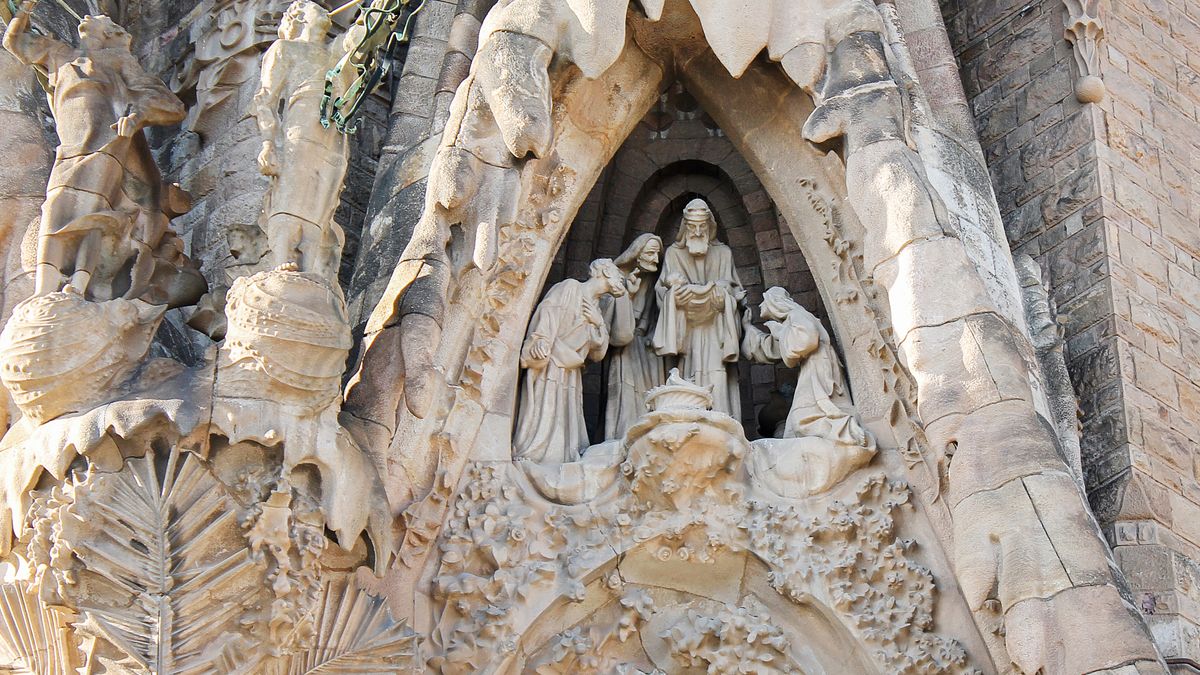
Approaching from Carrer de Provença, turn along Carrer de Sardenya towards Carrer de Mallorca to view the Passion façade. Look for the sharp edges of the figures and the spaces between them. The subject concerns suffering and death, so take time to read its sober mood. Avoid assuming that every visible element represents Gaudí’s own completed work.
Continue around the exterior to Carrer de la Marina for the Nativity façade. Here, for example, distinguish a human figure, a leaf and an animal within the crowded surface. Step back again to see how those details support the larger composition. Nearby park paths can offer breathing space, but keep paths and crossings clear.
Where does this exterior walk go wrong?
The main mistakes are viewing everything from too close, underestimating junctions and treating religious sculpture as decoration alone. Close views hide the overall shape, while rushed crossings break the walk’s rhythm. Looking only through a camera can also flatten the contrast between façades. Put the phone away briefly after each photograph and look again.
Park Güell belongs to a different outing, rather than a casual extension of this Eixample route. Park Güell sits on a hill. Keeping this self-guided Gaudi walking tour focused therefore protects time for the façades already on your route. You do not need another landmark to make the architectural comparison worthwhile.
What should you check before leaving the final stop?
Compare a distant view with one close detail at each building.
Keep the Passion and Nativity façades distinct in your notes or photographs.
Leave pavements, entrances and marked crossings clear.
Separate any interior visit from the exterior walking schedule.
Choose your onward destination before leaving the basilica area.
FAQ
These answers help you choose a direction, plan pauses and keep the exterior walk separate from any time inside.
Which Gaudí landmarks and façade details deserve a closer look?
Choose details that show how each building handles light. At Casa Batlló, compare reflective mosaic with recessed balconies. Casa Milà, on the other hand, rewards watching shadows under the stone curves. At the Sagrada Família, compare the deep modelling of the Nativity façade with the sharper forms of the Passion side. The differences remain visible without entering.
Where should a self-guided walking tour of Gaudí’s buildings begin?
Casa Batlló makes a useful beginning because the route follows Passeig de Gràcia towards Casa Milà before turning towards the basilica. Start with the building rather than a distant meeting point. Friends can gather somewhere that leaves the entrance clear, then cross at a marked crossing for the first broad view.
Can a self-guided Gaudí walk include interiors?
Interior visits need separate planning because the street itinerary does not account for time inside. Keep the exterior walk intact rather than treating an interior visit as a brief pause. You can still compare the three landmarks from public streets, including their surfaces, rooflines, balconies and relationship with neighbouring blocks.
Is the route suitable for walking with friends?
The route gives friends clear regrouping points at each landmark, but agree on which side of the street to meet. Broad views often require crossing away from the building. Avoid stopping together at narrow pavement sections, and pause conversations near the basilica when others are praying or reflecting.
Should you walk the route in reverse?
Reversing the route works, though it changes the architectural sequence. Starting at the basilica places the largest visual contrast first, then brings you back towards residential façades. The published direction builds from smaller details towards the church. Choose one direction and keep the stops together rather than repeatedly crossing the district.
Walk it with Xploreo
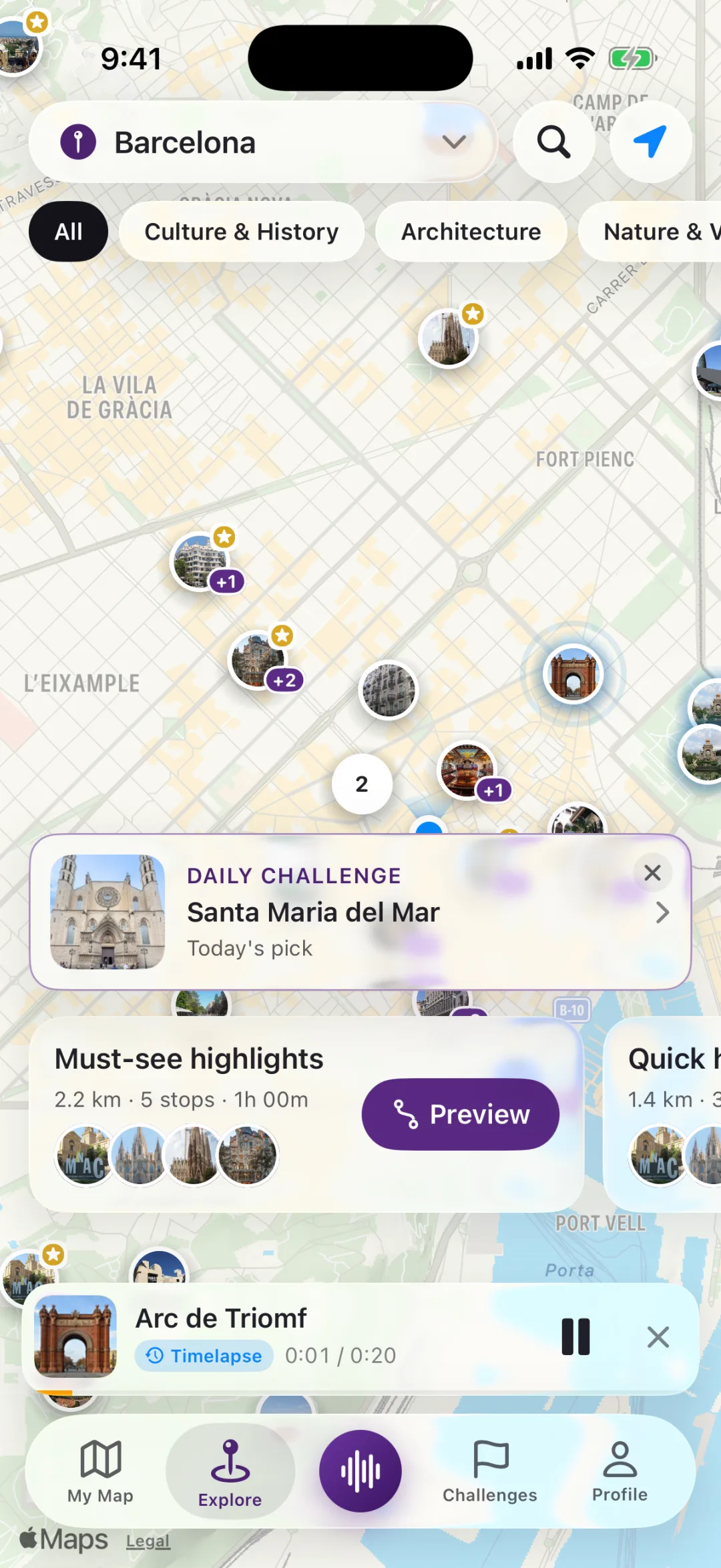
A self-guided Gaudi walking tour works best when the route supports looking, rather than constant screen handling. Our iPhone app builds walking loops from your position, or takes you towards a destination selected on the map. This published itinerary, by contrast, is a point-to-point walk.
Our short stories start automatically within about 50 metres of a stop and keep playing with the screen locked. Friends can join through a QR code or shared link. Up to five friends with the app join the host’s walk for 24 hours. Everyone hears the host’s story at the same moment in their own app language. No account is needed. Our guide explains how our audio walks work, including following a route while you listen.
The architectural thread is the lasting reward: colourful domestic detail, flowing stone and contrasting religious façades, all connected by ordinary city streets. Keep that thread in mind, and a self-guided Gaudi walking tour becomes more than a sequence of photographs. The spaces between the buildings help explain what makes each one different.
Our preference is to leave room for a second look rather than add another distant stop. We would spend that pause comparing the stone at Casa Milà with the street corner around it. For us, that small change of viewpoint makes the walk feel less like a checklist.
Keep this self-guided Gaudi walking tour focused on the buildings around you, with enough time to compare each façade from different viewpoints. Our Barcelona audio walks offer more context for exploring on foot. Get the app from the App Store.
Blog
Keep reading
 City walks
A self-guided walking tour of Barcelona's Gothic Quarter: 8 stops in 2 hours
A loop through the Barri Gòtic that starts and ends at the cathedral, with the Roman walls, the Jewish quarter and the bridge everyone photographs. Walk it with the app or with this page.
· 4 min read
 City walks
Rome after sunset: a 90-minute loop through the centro storico
Piazza Navona, the Pantheon, the Trevi Fountain and the Spanish Steps once the coaches have left. A short evening loop that starts and ends at Campo de' Fiori.
· 3 min read
 City walks
Berlin's Stolpersteine: how to read the brass stones under your feet
There are thousands of small brass plaques set into Berlin's pavements. What they say, who put them there, and why Xploreo shows them as their own layer rather than as stops.
· 3 min read